








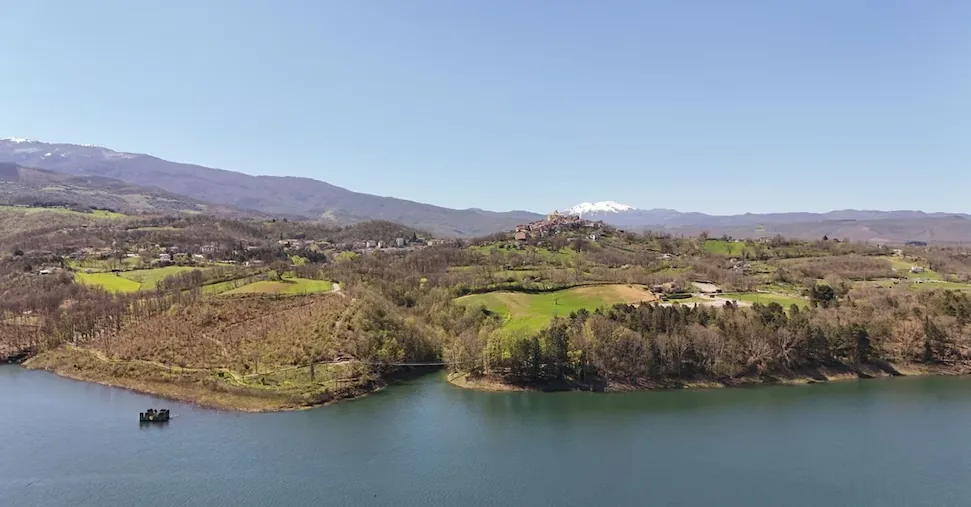
The “Extraordinary Water Plan” of the Southern Apennines Water District is close to completion: a 70 million euro project carried out over about six years and now almost finished. The core of the major intervention is to improve the efficiency of eight large dams by increasing their storage capacity by about 300 million cubic meters per year, and to create connections between water systems in Southern Italy to make them interconnected and, when necessary, deliver water where it is lacking.
Read more Millennial use of betel nut: traces of psychoactive substances on human teeth from 6,300-25,000 …
Ask the Sun
The questions are automatically suggested by 24Ore AI
based on the content displayed.
In times of drought, water rationing, and climate change, the issue is very pressing. When low water production due to drought is combined with structural deficits – such as low storage capacity, unsafe reservoirs often underutilized, leaky networks – water becomes a serious problem for citizens, businesses, and agriculture.
What effects will the completed works produce? “Certainly, greater storage makes water systems more resilient to water scarcity and reduces the risk of rotations and rationing. To make the benefit tangible, the optimal water supply of a drinking water system is on average 200 liters per day per inhabitant: assuming all the additionally stored volume is allocated to drinking water, 300 million m3 can supply over 4 million people consuming 200 liters per day for one year.” Roughly all the inhabitants of Apulia.
Until about five years ago, the southern regions already had a significant number and an interregional water connection network, but almost all these structures (mostly dating back to the 1960s and the Fund for the South) remained incomplete: untested dams, others completed but never used due to failures (such as the Acerenza-Genzano conduits in Basilicata), nonexistent or unfinished conduits. A system, in short, which although built with large public investments, and perhaps more structured than others in other areas of the country, in fact does not allow proper water management.
The new phase began with Law No. 145 of 2018, which entrusted Vera Corbelli, Secretary General of the Southern Apennines District, with the role of Extraordinary Government Commissioner, assigning her the task of making the former Eipli system efficient, the Agency for the Development of Irrigation and Land Reclamation in Apulia, Lucania, and Irpinia, a company transformed into Acque del Sud Spa: the entity that, once the works are completed, will be responsible for management. The goal of Commissioner Corbelli’s action is to carry out interventions to recover the storage volume of the entire system consisting of dams and large conduits of the Ofanto, Basento-Bradano, and Jonico-Sinni water schemes. In short, to connect three rivers and their related structures. It started with a funding of 25 million from the 2014-2020 Development and Cohesion Fund, then additional resources were gradually added. The latest being 16.5 million from the PNRR. A total of 68 million. Of these, 80% has been contracted.