








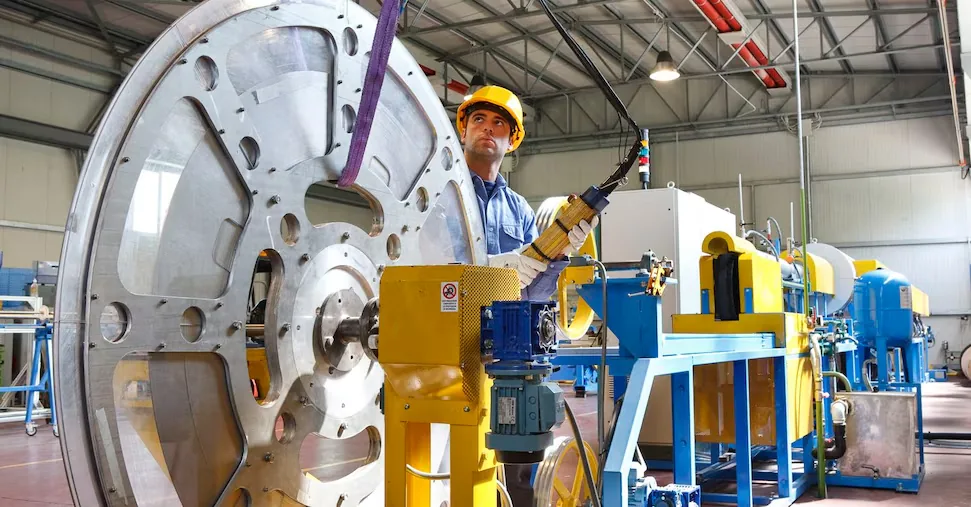
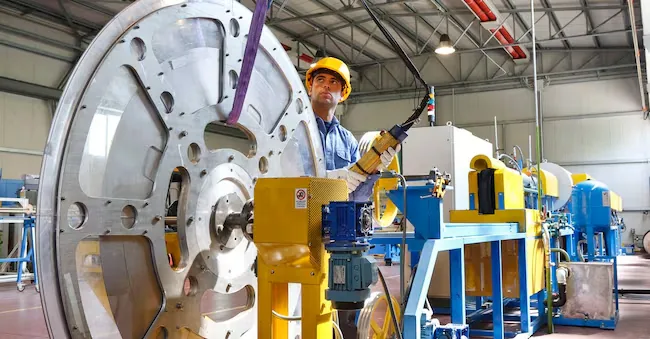
Start of production of the Made in Italy superconducting cable, designed for powering data centers. The project, named Sure (acronym for Superconducting – reliability & efficiency), originates from an agreement between Asg Superconductors (a company of the Malacalza group) and Infn (National Institute of Nuclear Physics), engaged with the Infn-Lasa laboratory in Milan, which leads the operation, and the National Laboratories of Frascati, also part of Infn. It is a superconducting cable, entirely produced with Italian and European technology, that has no heat dissipation (thus does not heat up), transports amounts of energy 10 times higher than a copper cable, eliminates losses due to electrical resistance, reduces bulk by 10 times compared to traditional cables, and is produced without the use of rare earths. The project is funded by the Ministry of University and Research, through the Italian Fund for Applied Sciences (Fisa), with a total funding of 5.8 million euros over five years, with completion expected in 2031.
Read more Hunger in the world is decreasing: but Africa surpasses Asia
Ask the Sun
The questions are automatically suggested by 24Ore AI
based on the displayed content.
Addressing the challenges of data centers
Sure, explain the companies involved, combines Infn’s expertise in frontier research, with particle accelerators, and Asg’s experience in designing and producing magnets, cables, and superconducting systems. The goal is to create a magnesium diboride (MgB₂) cable capable of addressing one of the main challenges of next-generation data centers: combining the growing demand for electrical power required, particularly by artificial intelligence applications, with energy efficiency and environmental sustainability. The project is a technology transfer initiative, developed from the results of the Iris project, funded by Mur with Pnrr funds, which is leading to the creation of a 1-gigawatt superconducting cable prototype for more efficient transport of large electrical powers.
Zoccoli: “Research can help create more efficient and sustainable infrastructures”
“We are talking about – says Antonio Zoccoli, president of Infn – a virtuous example of technology transfer from research to industry. The technologies developed by our institute, for frontier physics, now find a new application in a strategic sector such as data centers, whose energy demand is expected to grow with the development of artificial intelligence and high-performance computing. Moreover, they can also be used in many other fields characterized by high energy consumption. Projects like this demonstrate how research can contribute to creating more efficient and sustainable infrastructures, while fostering innovation and strengthening the country’s competitiveness.”
Read more Clashes in Bologna, Meloni: unacceptable violence against Law Enforcement
Davide Malacalza, president of Asg, emphasizes that the company has been investing “for years in the development of magnesium diboride superconducting cable technology, a solution that allows transporting significantly larger amounts of energy in reduced spaces. We are proud that this initiative, aimed at supporting the evolution of data centers, is born in Italy and represents, thanks to the partnership with Infn, a virtuous example of collaboration between industry and research, to address a strategic challenge of global relevance.”
Starting with the National Laboratories of Frascati
First of all, the new cable will be used to power the new data center of the Frascati Laboratories. Unlike the superconductors used in large particle accelerators, which require cooling with liquid helium at about 2 kelvin, the Sure cable uses, as mentioned, magnesium diboride, which operates at about 20 kelvin (-253 degrees Celsius) reducing cooling costs by over 10 times. This temperature can be reached through closed-cycle cryogenic systems, already widely used in industrial applications; which makes the technology easier to integrate and suitable for continuous use in data centers. At such a temperature, moreover, MgB₂ allows the transport of much higher amounts of energy, for the same bulk, compared to conventional cables, eliminating losses due to electrical resistance.
Read more Mps, to bankers richer supplementary health and pension benefits and an 8 euro meal voucher