








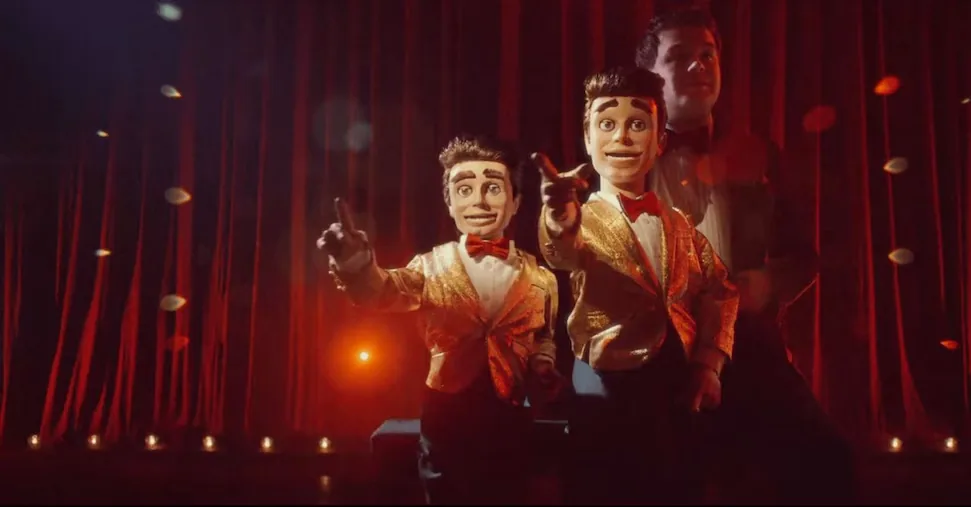
From the advanced artificial intelligences of today to the almost mystical practices of ancient Greece. The new campaign for the American market by the giant Mars spans more than twenty-five centuries, drawing inspiration for its new film airing this month from the ancient practice of ventriloquism. The campaign is called Double Act and was created for Twix. It turns two ventriloquist dummies into unlikely stars of a musical. The creative idea reprises the brand’s historic positioning – two is better than one – turning the two Twix bars into a metaphor for complicity. A commercial built almost entirely with practical effects, a surreal narrative, and calibrated humor. In short, here special effects come from performers highly skilled in the vocal technique capable of creating the illusion that the voice comes from another point.
Read more Israeli military investigations into deaths in Gaza: 57 cases without indictments
Ask the Sun
The questions are automatically suggested by 24Ore AI
based on the content viewed.
And to think that Mars is among the first multinationals to have invested in emotion AI to measure and optimize the effectiveness of advertising campaigns. The company developed one of the largest studies with over 1,500 consumers mapped in France, Germany, the United Kingdom, and the United States who watched more than 200 commercials while a webcam recorded their micro facial expressions. The goal was to verify whether the emotions elicited by the commercials could predict their commercial effectiveness. The result was reported by Forbes: emotion analysis proved more accurate than questionnaires alone in predicting short-term sales.
Emotions to translate
Reading emotions to sell better. After clicks, likes, and dwell time, the new frontier of measurement concerns what we feel. Thus, the market for platforms promising to transform attention and engagement into measurable data is growing thanks to artificial intelligence that decodes stress and engagement through micro facial expressions, posture, eye movements, and behavioral signals. The global market today is worth 3.4 billion dollars with a projected growth to 20.8 billion by 2034 according to the Indian market research company Fortune Business Insights.
Read more My grandfather inaugurates the first photo booth in Greece and plans expansion in major cities …
The algorithm reads the most hidden and precious part, that is the one linked to emotions, learning to decipher what we do not say. After the era of big data and predictive algorithms, the new oil is emotional data. To understand what excites us, bores us, scares us, or engages us. A perspective that opens huge opportunities for brands, retailers, and experience designers, but also raises ethical questions. “So far marketing measured the shadow, we measure the object: micro-expressions, pupil dilation, posture, validated physiological markers. We read the nervous system, which does not lie like a questionnaire. This is how we overcome the say-do gap and start from the biology of emotion, not pixels,” says Marco Baldocchi, CEO of Emotivae, an emotional AI and neuroscience platform that arrived in Italy thanks to the company Thymos.
“But invisible persuasion was not born with emotion AI: marketing has always persuaded with colors, music, layout. Persuasion works and is legitimate when it is transparent and respects choice. The problem is hidden manipulation that bypasses awareness. Emotion AI is a tool used to understand consumers’ emotional states and optimize their experiences to build loyalty,” says Baldocchi.
Read more Gioia Tauro, mega container port powered by the port’s electrical grid