







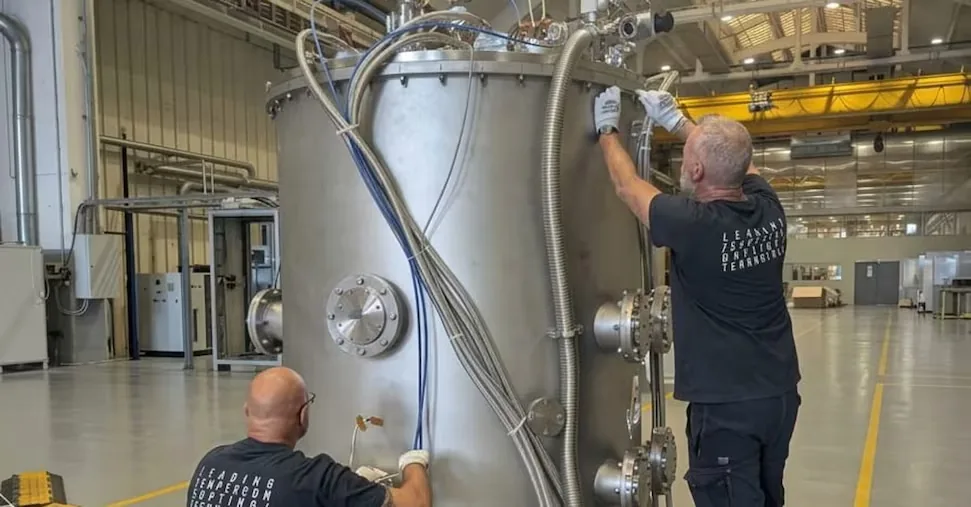
An Italian high-tech supermagnet lands in the USA. Lucio Rossi, project leader of the National Institute of Nuclear Physics (Infn) chaired by Antonio Zoccoli, presented in Pittsburgh, at Asc 2026 (Applied Superconductivity Conference, the most important global event dedicated to superconductive applications) the results of the machine’s test completions. It is, therefore, a high-temperature superconducting magnet (hts – high temperature superconductors) entirely made in Italy and funded under a Pnrr contract.
Read more Derailment of train in France, police favor sabotage theory
Ask the Sun
The questions are automatically suggested by 24Ore AI
based on the displayed content.
This particular type of device has the characteristic of operating with less energy expenditure compared to traditional superconducting magnets. This could allow future fusion power plants (clean nuclear) to be less energy-consuming. The same principle applies to medical and research fields, sectors that already operate with these machines, but also for potential uses in industry.
Less extreme temperatures
High-temperature superconducting magnets, unlike traditional superconducting ones, operate at less extreme temperatures: from 20 to 30 Kelvin degrees; in short, these are still very cold regimes but significantly higher than those required by traditional superconductors (from 2 to 4 Kelvin degrees) which have limited their application outside laboratories. This characteristic allows hts to have a simpler cooling system and, as mentioned, significant energy savings, lowering operational and management costs by several orders of magnitude.
Read more Diesel at an all-time high in Italy: Government considers targeted aid for workers and self-employed
Moreover, the challenge of producing magnets with hts materials, whose processing is very complicated and requires production processes that need much greater care and caution than those applied to traditional superconductors, has been ongoing for years and sees the United States and Asia, with Japan and China, at the forefront, investing large resources to fund research. Europe, which once held a leadership position in the sector, has now fallen behind.
Collaboration between Infn and Asg, under the aegis of Pnrr
For this reason, the presentation of the Italian magnet at Asc is particularly significant. It is made of rebco (copper, barium, and rare earth oxide) and develops over 5 tesla and 1 megajoule. The machine is the result of collaboration, under the aegis of Pnrr, between the Lasa group of Infn Milan and Asg Superconductors, a Ligurian company of the Malacalza family, specialized in superconductivity. It was built in the historic Genoese plants of the company, on the same site where, in the last 20 years, magnets for CERN in Geneva and for nuclear fusion projects Iter and Jt60 were born, as well as those for Fermilab and several international European research projects, including experiments at Gsi (Society for Heavy Ion Research) in Germany.
Read more Slow production in Lombardy