




Twenty-three billion dollars. This is the amount of United Nations procurement in 2025, with the largest contracts involving the health, logistics, and engineering sectors, followed by management services for humanitarian operations. The agri-food sector stands at around 1.6 billion. In this context, Italy is the 19th largest UN supplier by value of goods, with a total of contracts from the United Nations system amounting to about 345 million dollars in 2025 and about 8,000 suppliers registered on the dedicated UN portal. The main sectors concern services (management and transport) followed by medical-health goods. The main recipient agencies are FAO (89 million), WFP (55 million), and IFAD (35 million), followed by UNDP (26 million) and UNICEF (15 million).
Ask the Sun
The questions are automatically suggested by 24Ore AI
based on the content viewed.
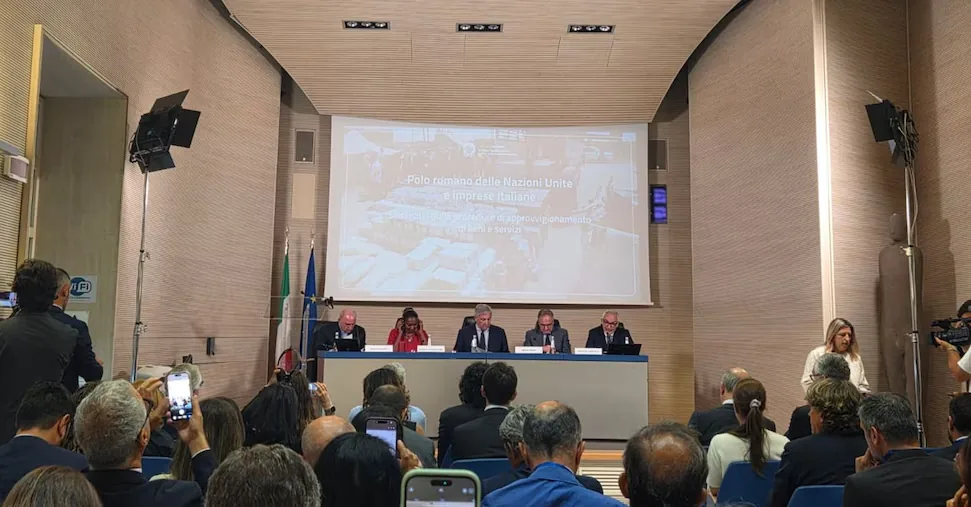
These data were presented on the occasion of the meeting held on Tuesday, July 14 at the Farnesina entitled “Rome hub of the United Nations – Seminar on procurement procedures for goods and services.” The meeting provided an opportunity to deepen the collaboration methods of Italian companies with the activities of FAO, WFP, and IFAD.
Tajani: «Italy an exemplary model on Gaza»
“Italy’s humanitarian and diplomatic commitment in major international emergencies, from Gaza to Sudan, is strengthened through increasingly close cooperation between institutions, UN agencies, and companies,” emphasized Foreign Minister Antonio Tajani, who spoke at the meeting. “We have sent an important signal of an Italy that does not look the other way, an Italy that also follows the populations who suffer the most, even the forgotten wars,” added the head of the Farnesina. The Deputy Prime Minister strongly claimed the results of Italian humanitarian initiatives, underlining how “on Gaza we have truly been an exemplary model,” calling it “the project that received the greatest number of approvals also at the international level” thanks to the ability “to speak both with Israelis and Palestinians.” A model that today extends to sub-Saharan Africa with the “Italy for Sudan” program, wanted by the government “to provide relief to populations who are victims of a forgotten war.” Tajani recalled that “in Sudan we have been, I believe, the country that more than any other has moved to provide relief to populations who are victims of a forgotten war. We have talked about it, we have also been protagonists of many other initiatives for this country that deserves to be assisted, especially the women and children who are victims of this war that continues to create many refugees, which also risks causing migratory phenomena not only towards Europe but also within the African continent, in addition to thousands and thousands of deaths. So our task is to work for peace, to build peace and to help those who are victims of war. We have done it and we will continue to do it through our international cooperation,” he concluded.
Read more Road safety, fatal accidents increasing within 72 hours on weekends
The FAO and WFP sector
Returning to the numbers of cooperation within the United Nations and going into specifics, the total value of FAO procurement amounts to 614 million dollars in 2025, with expenses mainly in the transport sector and the purchase of agricultural inputs. Italy is among the main suppliers of the organization, with a total of contracts amounting to about 89 million (followed by Afghanistan and South Sudan). As for WFP, the total procurement value amounts to 3 billion dollars, mostly for logistics expenses (1.2 billion) followed by food products.
Below are some indications that could be useful for companies interested in collaborating with FAO, WFP, and IFAD:
Read more Big concerts: what TicketOne is and how it works, the pioneering ticketing platform