



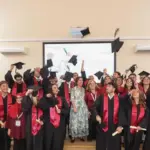





Three overtakes in the Corkscrew, no driver in the cockpit. At Laguna Seca, a symbol track of world motorsport, the University of Modena and Reggio Emilia won the Indy autonomous challenge by beating the US Purdue University in the final duel. Driving the Unimore Racing single-seater were not hands on the wheel, but the software developed by students and researchers of the university: a digital “driver” capable of reading the track, choosing the trajectory, and launching the attack. It did so three times right at the Corkscrew, the sequence of plunging curves that built the legend of Laguna Seca and which from today bears the name of Alex Zanardi, thirty years after his “The Pass” in 1996. The victory came at the end of the head-to-head race of the Indy autonomous challenge, a competition that turns the circuit into a high-speed laboratory for autonomous driving. In California, eight university teams competed: besides Unimore and Purdue, AI Racing Tech, which brings together Berkeley, Hawaii, San Diego, and Carnegie Mellon; Auburn University; Caltech; Indiana University; the Korean Kaist; and PoliMove-Tet, led by the Politecnico di Milano with Tecnológico de Monterrey and the collaboration of Michigan State and Lawrence Technological University. The second Italian team also made it to the podium, finishing third. Two national entities among the top three, confirming the importance of the Motor Valley and Italian research in automotive.
Read more Bessent at the G20: «Slowing China to rebalance global trade»
Ask the Sun
The questions are automatically suggested by 24Ore AI
based on the displayed content.
The peculiarity is that the hardware is the same for everyone. The competitors of the Indy autonomous challenge build their AV-24s starting from a Dallara chassis (here too beats an Emilian heart) derived from the Indy Nxt and adapting it to driverless driving. On board work radars, cameras, positioning systems, and high-performance computers. The sensors reconstruct what happens around the car; the software fuses the data and decides in real time how to brake, accelerate, steer, defend position, or overtake. This is where the race is played: in the algorithms, in the forecasting ability, and in the speed with which the system reacts beyond 200 kilometers per hour. The AV-24 is designed to exceed 190 miles per hour, over 300 kilometers per hour, making the track an extreme test bench for technologies also destined for Adas systems and autonomous road vehicles.
Read more The return exodus begins, red alert Saturday and Sunday: over 27 million vehicles on the roads
For Unimore, it is a success that comes from afar. The group led by Professor Marko Bertogna has been working for years on real-time computing, control, and autonomy and in 2025 had already set a record with the same AV-24 at the Modena Autodrome: 58.3 seconds per lap, one second less than the previous record set by a Lamborghini Huracán. At Laguna Seca, the further leap was to make the algorithm not only make fast decisions but competitive decisions, in traffic and against an opponent. The calendar leaves little time to celebrate. Tomorrow, September 5, Unimore and PoliMove will return to the track in Imola for the European debut of the Abu Dhabi autonomous racing league, A2RL, together with the Germans Tum and Constructor and the Kinetiz team from the Emirates. The cars will be identical Dallara super formula SF23, and once again, the software will make the difference. Unimore will once again start from pole position: from Laguna Seca to the Motor Valley, in less than forty-eight hours the driverless car challenge speaks increasingly Italian.
Read more Investments, for the post-Pnrr from utilities potential of 33 billion per year