








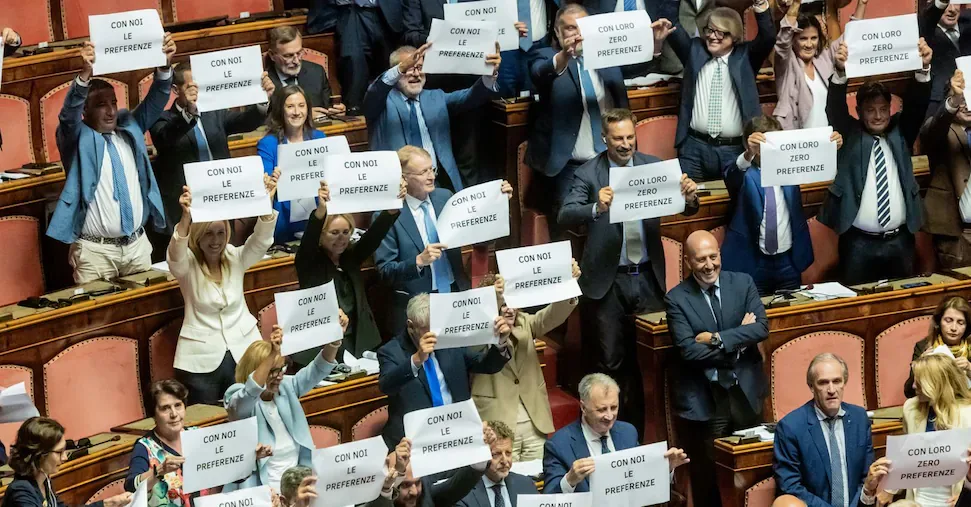
The reform of the electoral law accelerates in the Senate and introduces a decisive tightening on the signature collection for the presentation of lists for the upcoming political elections. A new amendment approved by the majority raises to 6,000 the number of signatures required for each constituency, effectively imposing on parties not present in Parliament a technical barrier of hundreds of thousands of paper signatures, to be collected in a very short time. While the center-right defends the measure as a necessary tool to discourage so-called “decoy lists,” extra-parliamentary forces denounce a structural entry barrier to protect already elected parties. Below is the analysis and reactions of the main political movements that today risk exclusion from the electoral race.
Ask the Sun
The questions are automatically suggested by 24Ore AI
based on the content viewed.
Onorato’s Civic Project
Among the entities involved is Progetto Civico Italia of Alessandro Onorato, councilor for Major Events, Sports, Tourism and Fashion of the Municipality of Rome, led by the PD mayor Roberto Gualtieri. It is a civic and centrist formation, within the center-left coalition (close to the M5S leader Giuseppe Conte). Onorato defines the rule as “yet another blow to the Constitution and democracy,” emphasizing that “forcing new political forces to collect 378,000 signatures in just 15 days means creating artificial obstacles.” The civic leader highlights the case of Valle d’Aosta where “the necessary signatures correspond to 11% of the votes.” Onorato has announced street protests and has appealed to the Head of State.
Italia Domani by Marco Rizzo
On the anti-system front is Italia Domani, led by Marco Rizzo, a political figure of communist background who has taken a sovereignist turn. Rizzo analyzes the text defining it as “a scam electoral law to lock down the system,” calculating the burden as “442,000 signatures just to have the right to appear on the ballot.” The paradox, according to Rizzo, lies in the fact that “on one hand there is a prospect of lowering the access threshold to representation to 1%; on the other hand, a preventive barrier is raised so huge that a new political force would have to collect more signatures than the votes needed to surpass that same threshold.”
Read more Emerging stress, Aidp on the front line
Communist Refoundation
The rule also heavily impacts the historic left. The Communist Refoundation Party, positioned on the far left, through Maurizio Acerbo and Gianluca Schiavon notes “an unreachable threshold,” defining the measure as an “attack on constitutional democracy” and a “favor to the caste,” since it exempts those already sitting in the Chambers. Within the center-left sphere, Avanti Psi, through its national president Luigi Incarnato, labels the requirement as “shameful,” calling it a “freedom-killing law” and hoping for intervention from the Quirinale to highlight its unconstitutionality.
The former League members of Patto per il Nord
Finally, in the area of territorial and autonomist movements, Patto per il Nord (founded at the end of 2025 by former League members) severely contests the operational constraints: “The Government majority not only did not accept the collection of signatures digitally, but has now also increased the required number by 4 times.” The movement speaks of an act “against democracy” which translates into an objective “invitation to abstain.”
Read more Pregnant woman killed in Gaza, Brics denounce violence and call for humanitarian access