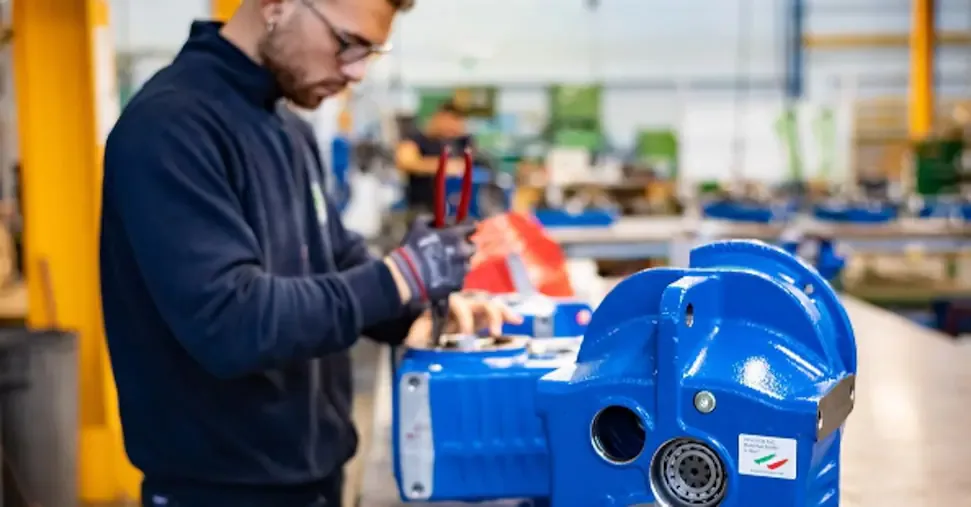










“The weight of energy costs for Arvedi Ast and for the Italian steel industries has become unsustainable.” This is the complaint from the group to which the Terni steel plant belongs. “We find ourselves operating in a European market characterized by strong competitive distortions and substantial discrimination against Italian producers,” the company states in a note. “We are not asking for favorable conditions, but that an Italian company competing in the European market can purchase energy on conditions comparable to those of its competitors,” it reiterates. “Italian producers are forced to source their main cost item in an energy market that is particularly penalizing compared to that of the main European competitors,” Arvedi Ast asserts. “The group – the note continues – has, since 2022, embarked on a relaunch path in Terni through a strategic investment plan aimed at boosting competitiveness by rebalancing and optimizing the plant’s production capacities, maximizing cold-rolled production, while simultaneously reducing the environmental impact of processes and transformation costs.” Arvedi Ast, with over 2,550 workers including direct employees and temporary staff, plus about a thousand from the supply chain companies, represents one of the main industrial and employment realities in Umbria.
Read more Fiumicino Airport, a few minutes of computer system outage
Ask the Sun
The questions are automatically suggested by 24Ore AI
based on the content viewed.
“The damages we are suffering – Arvedi Ast denounces – are such as to concretely put at risk the production continuity and the economic and employment sustainability of the company. In this context, the Arvedi Group, with the primary interest of protecting employment and the industrial future of its employees, has resolutely carried forward the investment plan of over 500 million euros, significantly anticipating the timelines set by the Program Agreement signed with the institutions. The widening of the energy cost differential compared to Arvedi Ast’s main European competitors will result in such a significant increase in production costs that, if passed on to sales prices, would put Arvedi Ast’s products out of the market, with significant consequences on production and thus employment levels.” “For Arvedi Ast – the note continues – it is now more than ever essential and strategic that the measures already identified and formalized among the commitments provided for in the 2025 Program Agreement be immediately implemented. These measures consist, on one hand, of access to a share of the hydroelectric energy produced in Umbria by the Galleto Plant at competitive economic conditions consistent with the actual generation costs of the plant and with the commitments made in the Program Agreement and, on the other hand, the introduction and full operation of the contribution for the use of stainless steel scrap. The timely implementation of these interventions is an essential condition to safeguard the competitiveness of Acciai Speciali Terni and guarantee its employment levels. The prolonged continuation of these penalizing market conditions will inevitably lead to measures impacting production continuity. The energy issue does not concern only Arvedi Ast. It concerns Italy’s ability to maintain strategic industrial productions, supporting investments, employment, and ecological transition.”
Read more Afd in Saxony-Anhalt: “Yes to weapons, but only for remigration campaigns and security …
“The issue raised by Arvedi-Ast regarding energy costs forces the acceleration of the reconvening of the Program Agreement table. It is through this instrument that institutions and the company have taken on, with mutual and detailed commitments, a fundamental responsibility in shaping the productive and employment future of the Terni site,” said the Umbrian regional councilor for Economic Development and Labor, Francesco De Rebotti, following statements by Arvedi-Ast CEO Dimitri Menecali on the difference in energy costs borne by the Italian steel industry compared to main European competitors. “The energy issue is not something that emerged today,” he adds. “It was in fact one of the main critical issues that emerged in the long process leading to the signing of the Program Agreement,” De Rebotti states in a note, “after a phase marked by continuous postponements and difficulty in finding conditions capable of supporting the site’s competitiveness. Precisely for this reason, the Region began working on the issue, aware that energy costs represent a decisive variable for the future of an industrial reality like Ast and, with it, for the entire economic and employment system of Terni and Umbria.”
Regarding what was declared by the Umbria Region on the Program Agreement for Acciai Speciali Terni, sources from the Ministry of Enterprises and Made in Italy (Mimit) specify that all commitments that the Agreement, signed in July 2025, places on the Ministry have been respected. On the energy front, Article 7 of the Agreement, dedicated to energy costs, does not assign any specific commitment to the Ministry. The measures provided are attributable to commitments made by the Region, also in coordination with the company: the verification of mixed management forms of large hydroelectric derivations, the reservation of a share of production for energy-intensive Umbrian companies, and solutions for the Pentima Plant. The Government’s commitment concerned support for the use of stainless steel scrap. Article 6-bis of the Agreement provided for the presentation to Parliament, by December 31, 2025, of a provision introducing a tax credit for electric furnace steelworks producing stainless steel from scrap. The commitment was met on time: the measure was introduced with the budget law (Article 1, paragraphs 801-805, of Law 30 December 2025, no. 199). The provision is now subject to a notification process to the European Commission for verification of compliance with the State aid discipline for climate, environment, and energy 2022 (Ceeag). This is the necessary step for the implementation of the measure. The Ministry is following it together with all competent central administrations and the company, and this has been the focus of discussions in recent months. The Ministry, sources further specify, shares the need to put Ast in a position to compete in a European market marked by strong differentials in energy costs. On this issue, the Government is also engaged at the European level, protecting a strategic site for national steelmaking. To review the implementation of all commitments, both public and private, Mimit will urgently convene the inaugural meeting of the Executive Committee provided for in Article 9 of the Agreement and the verification table of the Program Agreement. At that meeting, each Party will report on the commitments within its competence.
Read more Superenalotto, hit “6” of 223 million in Lecchese